George's Memorial Pasture
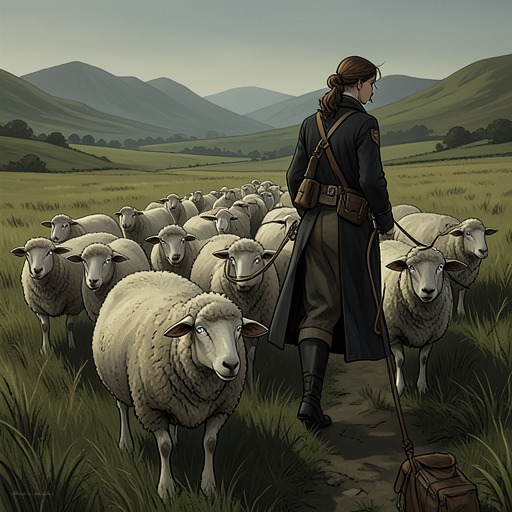
Three Bags FullGeorge's Memorial Pasture is a protected patch in the meadow, established by George Glenn's flock after George Glenn's death. The sheep choose a place where their favorite herbs grow and forbid grazing there, turning a familiar part of their pasture into a memorial. Its boundary is both practical and symbolic: to keep the grass untouched is to preserve a place for George Glenn in the flock's daily landscape.
Setting and Designation
The sheep do not choose George Glenn's vegetable garden, which has already been eaten bare. Instead, they find a herb-rich patch at the foot of the hill and set it aside as George's Memorial Pasture, also called George's Place. The contrast matters: the garden had been fenced off from them during George Glenn's life, while the memorial is a rule they impose on themselves. Establishing it gives their grief a visible form and brings them immediate relief.
The pasture remains part of the meadow rather than a separate human-built monument. Its significance comes from what the sheep do there—and refrain from doing. A patch otherwise valued for grazing becomes a shared, deliberately preserved space, with the flock's own custom protecting its association with George Glenn.
The Grazing Ban and Its Breach
The rule is tested when Miss Maple later sees a fresh, broad trail of grazed ground running through the middle of George's Place. At first she suspects Mopple the Whale, but the flowers left standing amid the eaten plants change her reading. The slender, sweet-smelling nose-tickler flowers are among the flock's favorites, and she knows of one sheep who dislikes them. That detail makes the damage look less like indiscriminate grazing and more like a deliberate choice by someone who would naturally leave those flowers uneaten.
For Miss Maple, the breach carries a meaning beyond lost forage. If a sheep has grazed there on purpose, she reasons, that sheep may not want to remember George Glenn; violating the memorial is therefore an insult. The pasture's rule turns an ordinary trace in the grass into a clue about an individual sheep's attitude, though the evidence does not establish that sheep's identity. The incident also sharpens Miss Maple's attention to the murder investigation.
Land, Use, and Narrative Significance
The memorial patch sits within a wider landscape contested by different ideas of value. In talk about the land after George Glenn's death, villagers describe its sea view as wasted on sheep and imagine commercial uses for the property; accusations about drugs and nighttime boats further complicate the pastoral setting. These claims concern the surrounding land, not the memorial patch specifically, but they expose the pressure on a meadow that the flock experiences as home and sustenance.
George's Memorial Pasture offers a small counterclaim to that instrumental view. The sheep do not measure this patch by its potential price or productivity: they mark it through restraint, memory, and a rule they choose to keep. That the rule can be broken—and that the manner of its breaking can be read—gives the place an active role in the story. It is at once a memorial, a test of the flock's shared obligation, and a surface on which grief and suspicion leave visible traces.